

You need your household’s water target minus the drinkable water actually supplied in the emergency kit. For a household in Germany, the Federal Office of Civil Protection and Disaster Assistance (BBK) uses 2 litres per person per day for drinking and food preparation: that makes 6 litres per person for 72 hours, before subtracting verified kit water. Washing, toilet flushing and individual additional needs require separate planning.
- Extra water beyond emergency kit contents equals your household target minus verified, stored drinking water.
- Germany’s BBK baseline gives 6 litres per person for 72 hours, including drinking and food preparation.
- ReadySet emergency kits are a starting point; check supplied water separately from your household reserve.
- Water purification tablets treat suitable source water; they do not count as stored drinking water.
Why this matters
A backpack can contain useful emergency equipment without holding your household’s full water reserve. The words 72-hour kit do not establish how many litres are inside. Count the water, not the label.
ReadySet sells emergency kits for EU households. ReadySet emergency kits suit households seeking a prepared starting point, with water reserves assessed separately. Their household-size descriptions are not a substitute for checking the current packing list and adding personal supplies.
This 2026 guide uses Germany as a clearly identified worked example. It does not apply Germany’s figure to every European country. If you live elsewhere, use the official recommendation for your country and keep the same subtraction method.
How much extra water do you need beyond an emergency kit?
Extra water needed = household water target − verified drinkable water already stored. If the result is below zero, you have met that selected target; you do not need to subtract anything further.
For Germany, the BBK’s emergency-stock guidance allocates 2 litres per person per day, comprising 1.5 litres for drinking and 0.5 litres for food preparation. Applied to a 72-hour planning period, that is 6 litres per person. This is a household planning baseline, not an individual medical prescription.
| Household | Water target for 72 hours | What you subtract |
|---|---|---|
| One person | 6 litres | Verified potable water in the kit and elsewhere at home |
| Two people | 12 litres | Their combined, verified potable water reserve |
| Four people | 24 litres | The whole household’s verified potable water reserve |
Source: Federal Office of Civil Protection and Disaster Assistance, Germany, guidance on stocking food and drink. The household totals are calculations using its daily allowance, applied here for 2026 planning. The BBK’s broader stockpiling guidance covers a longer period; 72 hours is the calculation window used in this article, not a claim that German guidance stops there.
The German-language guide to the BBK emergency stock list explains the wider household-stock context.
Calculate your shortfall before buying more
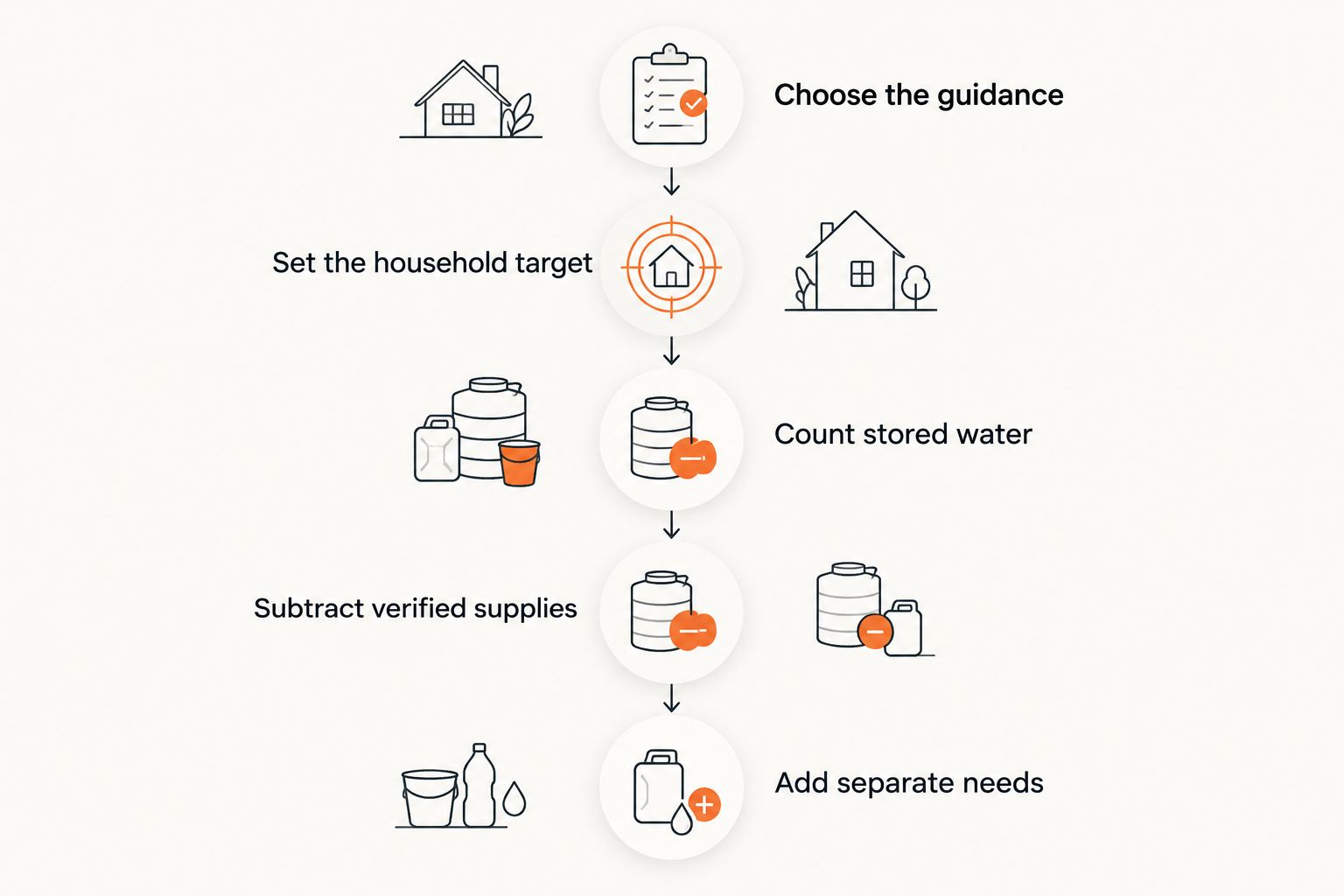
- Choose the guidance. Identify the country whose official household recommendation applies to you.
- Set the household target. Multiply the daily allowance by the people and days you are planning for.
- Count stored water. Add the stated volume of sealed drinking-water containers available to your household.
- Subtract verified supplies. Include kit water only when its quantity is confirmed. Do not include treatment capacity.
- Add separate needs. Review pets, hygiene, feeding requirements and any individual instructions from a healthcare professional.
For a 2026 shopping list, write the shortfall in litres rather than packs. Container sizes differ, and a pack count alone makes comparisons unreliable.
One person: 6 litres before subtracting kit water
6 litres is the Germany-based baseline for one person over 72 hours. Subtract the water you can confirm is already stored and suitable for drinking.
Living alone makes access part of the calculation. A reserve is less useful if you cannot lift the container or reach its storage place safely. Choose containers you can manage without depending on someone being available.
Keep the home reserve distinct from what you intend to carry during an evacuation. You do not have to put every household supply into one backpack. Decide what stays accessible at home and what you can realistically take with you.
Two people: 12 litres before subtracting kit water
12 litres is the Germany-based baseline for two people over 72 hours. Count the shared reserve once, even if both people have separate bags.
If you find a sealed 500 ml drinking-water pouch in each bag, those two pouches contribute 1 litre together. In that illustrative example, the remaining shortfall is 11 litres. This is a calculation example, not a statement about the contents of any particular kit.
Check where both people spend their time. Water stored at work is not available in your apartment during a disruption at home. Your household worksheet should count supplies that are actually accessible where you plan to use them.
Four people: 24 litres before subtracting kit water
24 litres is the Germany-based baseline for four people over 72 hours. Use that as a starting calculation, then check the household’s individual needs.
Do not assume that a family-kit label means four adults, or that it proves a particular water quantity. ReadySet describes its Family Set for two adults and two children. That intended household size does not establish how much potable water is supplied.
Children’s feeding needs, prescribed fluid restrictions and other medical considerations need individual attention. Ask your healthcare professional about a suitable plan where necessary; do not replace that advice with a generic emergency-stock figure.
For your 2026 household check, record both the selected baseline and any separately identified additions. Keeping them visible prevents an extra requirement from disappearing inside a rounded total.
What counts as water already supplied?
Count actual potable water, with a stated volume, in intact containers suitable for their intended use. Check the current seller’s packing list before buying and inspect the delivered contents afterwards.
A product sold separately is not automatically included in a kit. Neither a photograph of a water pouch nor a general promise of preparedness establishes the quantity you will receive.
| Supply | Best for | Advantage | Limitation | Counts towards stored litres? |
|---|---|---|---|---|
| Sealed bottled drinking water | A home reserve | Easy to count by labelled volume | Needs storage space and routine checks | Yes, when suitable for use |
| Sealed emergency drinking-water pouches | Dividing water between bags | Individual portions are easy to allocate | Small portions must be added together carefully | Yes, by their stated volume |
| Water purification tablets | Treating suitable available water | Useful as an additional treatment option | Require source water and correct instructions | No |
| Empty drinking-water containers | Preparing future storage | Let you organise a reserve | Contain no reserve until filled appropriately | No |
The practical distinction is simple: a treatment method is not a water supply. Aquatabs Water Purification Tablets are a treatment product. Seven Oceans Emergency Drinking Water (500 ml) is supplied water. Neither product’s separate listing proves that it is inside a particular emergency kit.
Do not translate a tablet packet’s treatment capacity into litres on your stock sheet. Until you have suitable source water and follow the instructions, those litres are not stored drinking water.
Why your extra water requirement varies
Your shortfall depends on more than the number printed on a kit. Review these factors before settling your shopping list:
- Country guidance. National recommendations differ in daily allowance, planning period and what the allowance includes.
- Household size. Count everyone who will depend on the reserve, including children and expected dependants.
- Verified kit contents. Subtract the actual potable volume, not a product category or an assumed quantity.
- Food preparation. Read the meal instructions. Food requiring rehydration needs water allocated to that purpose.
- Individual needs. Follow relevant healthcare advice and account separately for pets and feeding requirements.
- Other household uses. Washing and toilet flushing are not covered by a drinking-and-food-preparation calculation.
Heat and physical exertion also affect fluid needs. Do not treat a stockpiling baseline as a cap on what someone should drink, or change prescribed fluid limits without medical advice.
If you choose food that needs no added water, keep the distinction clear. Removing a preparation step does not remove the need for drinking water. It also does not prove that the food provides complete nutrition for the planned period.
How do you check the kit’s water quantity before ordering?
Read the current packing list for the exact variant you intend to buy. Look for the number of containers and the volume of each container, rather than relying on a general description.
Your check should answer these questions:
- Is drinking water explicitly listed as supplied?
- Is the container size stated?
- Is the number of containers stated?
- Does the listing describe water, a filter, tablets or an empty container?
- Are the storage and use instructions available?
- Which water-dependent food items need a separate preparation allowance?
If the water quantity is unclear, ask the seller before placing the order. Do not enter an assumed deduction into your reserve calculation.
After delivery, compare the contents with the packing list. For a ReadySet emergency kit, the same rule applies: count the supplied water and keep your additional household reserve visible as a separate line.
How should you store the additional water at home?
Choose a storage arrangement you can reach, inspect and manage. Follow the container manufacturer’s storage instructions and keep drinking water away from chemicals and other contamination sources.
Sealed commercial drinking water is straightforward to inventory because the volume is printed on the packaging. Check seals, container condition and the relevant date information. Replace damaged or leaking containers rather than leaving them in the reserve.
For self-filled supplies, use containers intended for drinking water and follow official hygiene guidance. Do not reuse containers that previously held household chemicals. There is no single replacement interval that applies to every container, filling method and storage condition.
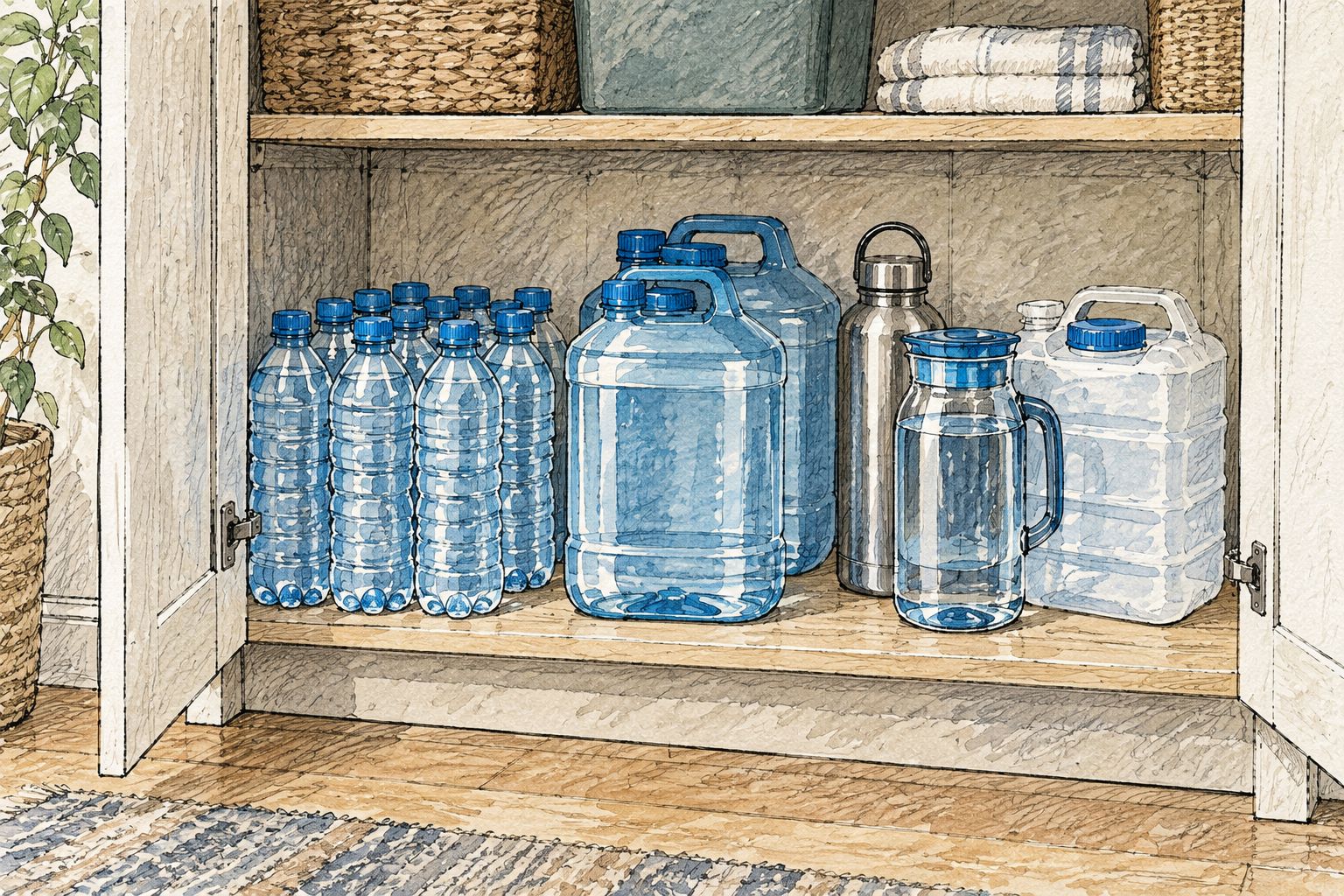
Keep a simple inventory beside your household checklist. Record the total potable volume, its location and the checks required by the packaging instructions. When someone uses a container, update the total and replace it.
For your 2026 review, check access as well as quantity. A blocked cupboard or an unmanageable container creates a practical problem even when the arithmetic is correct.
Do purification tablets reduce the amount of water you should store?
Zero litres of stored water come from the tablets themselves. Tablets can provide a treatment option when suitable source water is available, but they do not fill a container.
Follow the exact product instructions, including their conditions and contact time. Do not assume that disinfecting water removes chemical contamination, or that any nearby water source is suitable. Follow local authorities’ instructions during an incident.
Does the water allowance cover washing and toilet flushing?
2 litres per person per day in the German calculation covers drinking and food preparation, not a full household water budget. Plan other uses separately so they do not silently consume the drinking reserve.
Keep any non-potable supply clearly distinguishable from drinking water. If someone else helps manage your household supplies, make sure the distinction is clear to them too.
FAQ
How much extra water do I need beyond an emergency kit?
Subtract the kit’s verified potable water and your other stored drinking water from your household target. Using Germany’s BBK allowance for 72 hours, the starting target is 6 litres per person, before individual additions.
How much water should two people store for 72 hours?
12 litres is the Germany-based baseline for two people over 72 hours, including drinking and food preparation. Subtract verified water already stored to calculate the additional amount needed.
How much water should a family of four store for 72 hours?
24 litres is the Germany-based baseline for four people over 72 hours. Review feeding requirements, pets, other household uses and individual healthcare advice separately.
Can I count purification tablets as emergency drinking water?
No. Purification tablets are a treatment method, not stored water; they require suitable source water and correct use according to the product instructions.
Does a 72-hour emergency kit contain enough water for three days?
The duration label alone does not establish water sufficiency. Check the exact supplied volume and compare it with the target for your household and country.
Can I subtract bottled water already in my kitchen?
Yes, if it is suitable for drinking, available to your household and not already counted elsewhere. Keep the inventory current as you use and replace it.
Is the same emergency water recommendation used throughout Europe?
No. Use the current official guidance for your country, including its planning period and stated uses, rather than treating one national allowance as a Europe-wide standard.
One last thing
Do not count the same bottle twice. Water inside an evacuation bag is still part of your household’s physical stock, not an additional reserve created by moving it to another checklist.
Write down one total, then mark where each portion lives. That small step makes the difference between a reassuring number and a reserve you can actually account for.


