

Check an emergency kit’s contents before buying by matching the seller’s itemised packing list to your household size, then checking quantities, food labels, water volumes and operating instructions. A 72-hour label does not establish that the kit supplies all the water, food or personal essentials you need; record those additions separately before ordering.
- Check emergency kit contents before buying: verify quantities, instructions and household additions, not just the product photograph.
- ReadySet emergency kits target different household sizes; inspect the selected kit’s current packing list before ordering.
- Count stored drinking water separately from water-treatment tablets, and check food energy and allergens on the label.
- Save the packing list so you can compare the delivered contents with what you ordered.
Why this matters
A neatly packed bag tells you little about what your household can actually use. The useful details sit in the packing list: how much drinking water, which food, how many individual items and what needs charging or assembling.
For a 2026 purchase, use the current listing for the exact variant you select. If you are inspecting The Duo Set, start with its stated household of two adults, then verify the individual quantities rather than assuming every shared item appears twice.
Buy against a packing list, not a photograph. Keep a separate list of the supplies you already have at home; otherwise, you risk counting the same reserve twice or overlooking an essential addition.
How do you check an emergency kit’s contents before buying?
Use this sequence while the product page is open. Keep your notes beside the listing so unanswered questions remain visible rather than disappearing into a general impression that the kit looks complete.
- Confirm the exact variant. Check the selected household size, product name and any options that change the contents.
- Find the itemised list. Look for named components and quantities, not just categories such as food, warmth or communication.
- Check consumable amounts. Record drinking water in litres and food energy from the label, alongside the number of packs supplied.
- Read the instructions. Check preparation, charging, batteries, connectors and any other requirements for use.
- Separate household additions. List extra water, suitable food, medication, documents and other personal supplies outside the supplied contents.
- Resolve gaps before ordering. Ask the seller to confirm anything that affects suitability, then save the answer with the packing list.
A useful inspection record has three columns: Supplied contents, Household additions and Questions to resolve. Every item belongs somewhere; an unclear quantity belongs in the questions column, not the supplied column.
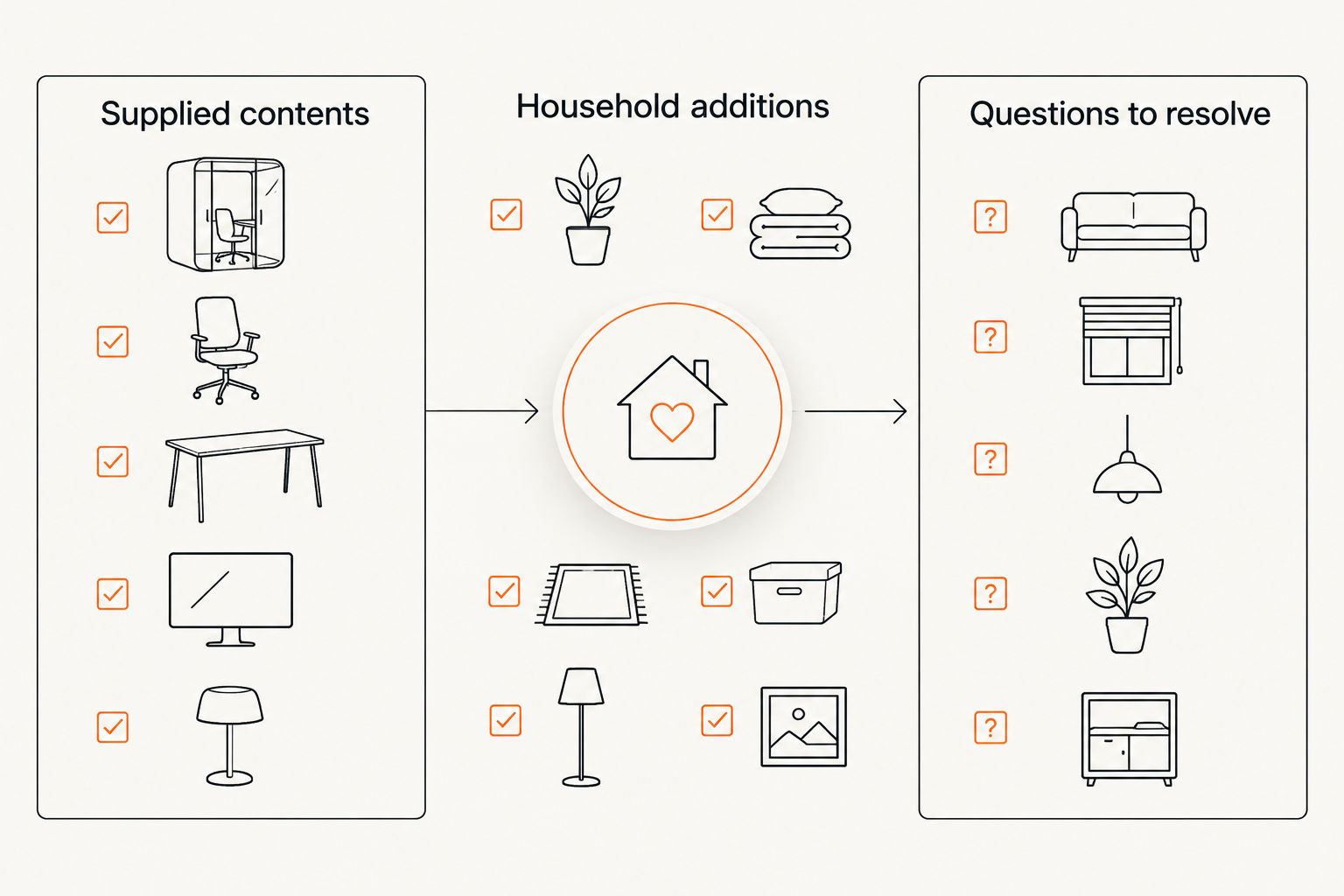
What counts as a useful packing list?
A useful packing list identifies what arrives and how much of it arrives. For food, a product name without the number of packs leaves the total uncertain; for a radio, a model name without operating instructions leaves practical questions unanswered.
Look for agreement between the selected variant, written description and contents image. If they conflict, ask which list applies to your order. Do not silently choose the most generous interpretation.
Check household size before counting individual items
Two adults are not the same household as two adults and two children. The supplied product descriptions distinguish those groups, so use that distinction throughout your inspection rather than treating every person-count label as interchangeable.
Your own household list should also capture needs that a standard packing list cannot settle. Include dietary restrictions, mobility limitations, glasses, hearing-aid supplies and any care arrangements that affect how someone accesses or uses the equipment.
ReadySet emergency kits are best suited to EU households seeking a ready-made starting point for 72-hour preparedness. The advantage is a preassembled selection; the limitation is that household-specific suitability still needs checking. A ready-made kit does not remove the need to assess personal supplies or additional reserves.
For your 2026 comparison, write the household description at the top of the worksheet. That small step keeps you from comparing a two-adult kit with a family variant and mistaking different intended users for different levels of completeness.
Count drinking water separately from water treatment
Stored drinking water and water-treatment tablets do different jobs. Stored potable water is a physical reserve; tablets require a suitable water source and correct use according to their instructions.
The supplied store listing describes a Seven Oceans drinking-water pouch as 500 ml. It describes Aquatabs as treatment tablets, not as containers of stored water. Neither detail establishes how many pouches or tablets are included in a particular kit.
| Packing-list entry | What it contributes | What you still need to check | Main limitation |
|---|---|---|---|
| Stored drinking water | A stated volume of potable water | Volume per container and number supplied | The included volume might not match your household reserve target |
| Water-treatment tablets | A way to treat suitable source water according to instructions | Product instructions, dosage and source requirements | Tablets are not stored drinking water |
| Additional household water | A separate reserve you arrange | Your chosen target and existing usable supply | It must be counted and stored separately |
Record the kit’s confirmed potable-water volume before comparing it with current official advice for your country. Do not apply one European household target everywhere, and do not count a tablet’s treatment capacity as water already available in your home.
For example, a listing that says only water included leaves an important question open. Ask for the container size and quantity so you can calculate the actual supplied volume.
Read food labels, not just the word ration
Food weight, energy and suitability are separate checks. The supplied listing for Seven Oceans Emergency Food Ration describes a 500 g pack providing 2,500 calories, with wheat among its ingredients.
Those figures describe that individual product. They do not establish the number of packs inside a kit, whether the food suits everyone in your household or whether the kit provides complete nutrition for 72 hours.
Ask for the current label and preparation instructions. Check ingredients, allergens, energy per pack, serving information and whether eating the food requires water, heating or another item that must also be available.
For a 2026 order, ask how the seller communicates the supplied batch’s best-before information. A general shelf-life statement is not the same thing as the date printed on the pack you receive.
Do not mark food as suitable until both quantity and dietary needs are checked. For a two-person household, record the total supplied energy first; then assess it alongside the other food you plan to store, rather than assigning the entire pack to each person.
Check whether you can use the equipment as supplied
An equipment list should lead to a practical question: what must happen before this item works? A lamp needs an understood power source, a rechargeable device needs a charging method, and shared equipment needs an agreed storage place.
Look for the instructions before buying. Confirm whether cables, batteries or other necessary accessories are included, and distinguish built-in features from separate items shown beside the product.
The supplied ReadySet radio listing names a 10,000 mAh power bank. That capacity alone does not establish how many times it will charge your particular phone; avoid turning a battery-capacity figure into an unsupported promise about household runtime.
If an instruction is unclear, ask a specific question. Whether the required charging cable is included is a more useful question than whether the equipment is easy to use.
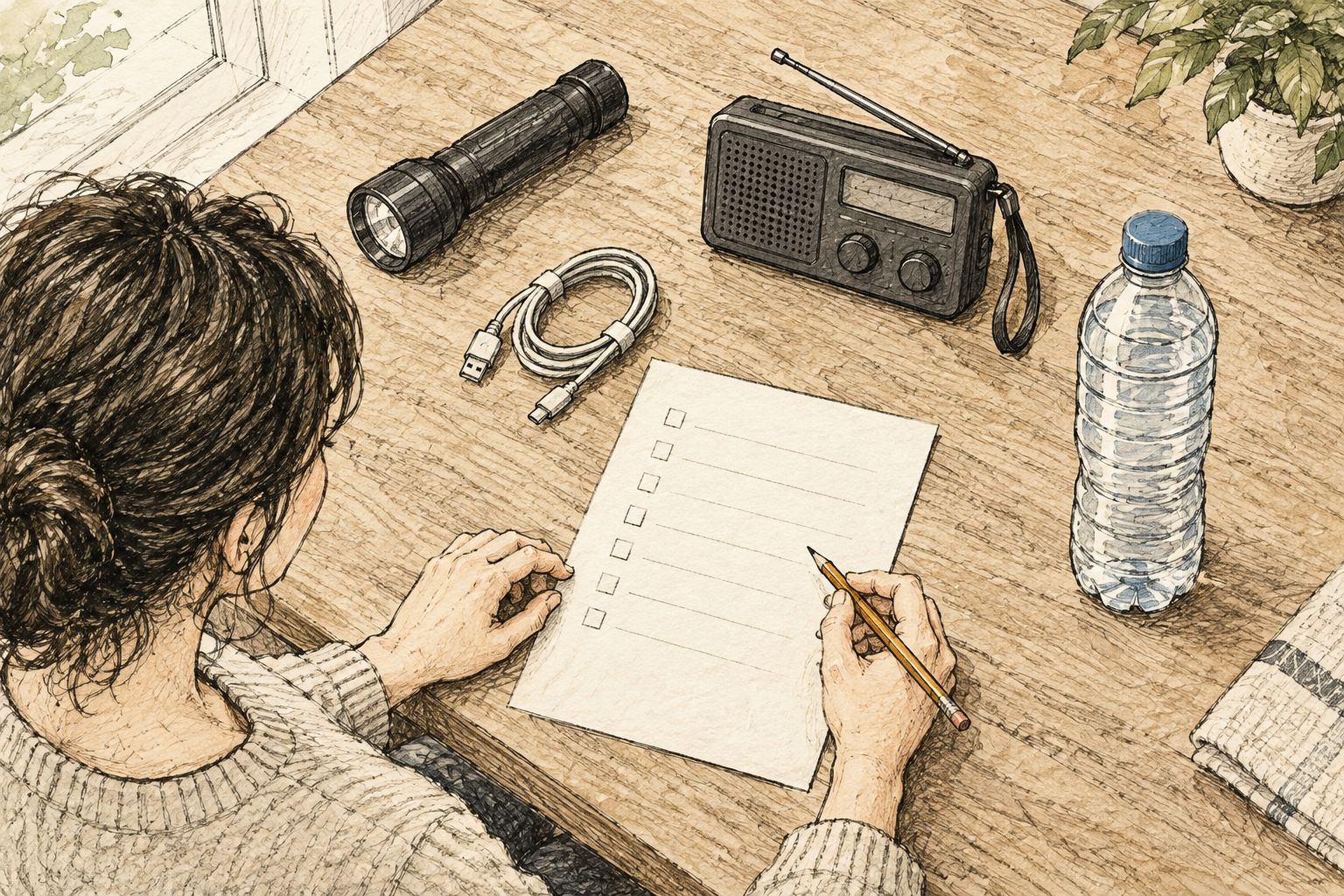
An inspection scene can help you picture the task: place the packing list beside the equipment and check each dependency, rather than treating the bag as one indivisible purchase.
Why the contents you need vary
The right packing list depends on the household and how the supplies will be used. Use these factors to explain differences between kits without assuming that more components automatically means a better fit.
- Household composition. Confirm the intended mix of adults and children, not just the total headcount.
- Food suitability. Check ingredients, allergens and preparation requirements against the people who will eat it.
- Existing reserves. Distinguish supplies already stored at home from quantities arriving in the kit.
- Equipment dependencies. Identify charging methods, batteries, cables and instructions before counting a device as ready.
- Access and transport. Consider where supplies will live and whether household members can reach and carry them.
- Personal needs. Keep medication, documents, care information and individual aids on a separate checklist.
These factors also explain why a long component count is a weak buying shortcut. A shared tool and an individually needed supply serve different purposes; counting both as one item does not make them equivalent.
Turn the packing list into a household readiness check
Once the contents are clear, follow the path from storage to actual use. Where will the bag go? Who knows the location? Which items remain in a cupboard, and which need to leave with you?
Lighting illustrates the difference between ownership and readiness. Your plan for charging torches during a power cut should identify the torch’s power source and compatible charging equipment before the usual socket supply is unavailable.
Apply the same check to communication and food preparation. A device that needs an unavailable accessory, or food that needs a preparation method you have not arranged, leaves a practical gap despite appearing on the packing list.
Save your 2026 inspection notes with the order confirmation. You will then have one record of the selected variant, confirmed quantities, outstanding additions and any written answers from the seller.
What should you ask the seller before ordering?
Ask questions that change your decision. Start with missing quantities or unclear instructions, then move to details that affect your household’s ability to use the contents.
- Does this packing list apply to the exact variant selected?
- How much packaged drinking water is supplied in total?
- How many food packs are included, and can I read their current labels?
- Which necessary cables, batteries or accessories are included?
- Where can I read the operating and food-preparation instructions?
- How are changes or substitutions communicated before ordering?
Keep the answers. If an unresolved point affects food suitability, water quantity or equipment operation, wait for confirmation rather than filling the gap with an assumption.
This approach applies to ReadySet and any other seller. It is a check of the particular order, not a claim that one brand’s standard selection suits every household.
Does a 72-hour label mean everything is included?
A 72-hour label describes the kit’s intended preparedness period, not proof of complete household sufficiency. You still need the supplied quantities, instructions and personal-additions list to assess what the kit actually covers.
Treat words such as complete as a prompt to inspect the detail. The useful evidence is the itemised list and the labels for the actual contents.
Can two adults rely on one shared packing list?
Two adults can use one household packing list, but the list must distinguish shared equipment from individually needed supplies. Record total food and water quantities once, then assess whether they cover both people alongside your additional reserves.
Also check access. Shared supplies only help when both adults know where they are and how to use them.
What should you check when the delivery arrives?
Compare the delivered contents with your saved packing list before putting everything away. Check quantities, packaging, labels and accessories, then follow the manufacturer’s instructions for setup and familiarisation.
Keep your 2026 purchase record, but use the dates and instructions on the delivered items for ongoing checks. Photograph any discrepancy and contact the seller while the order details are easy to identify.
FAQ
How do I check emergency kit contents before buying online?
Match the selected variant to an itemised packing list, then verify quantities, labels and instructions. Keep additional household supplies in a separate column and ask the seller to resolve unclear details before ordering.
Is a product photograph enough to confirm what is included?
No, a product photograph is not enough to confirm the delivered contents. Use the written packing list and ask the seller to explain any difference between the image, selected variant and description.
Do water-treatment tablets count as drinking water in a kit?
No, water-treatment tablets do not count as stored drinking water. Record packaged potable-water volume separately and follow the treatment product’s instructions when assessing its role.
Does a 72-hour emergency kit provide all the food we need?
A 72-hour emergency kit label alone does not establish complete food coverage. Check the number of food packs, energy totals, ingredients and preparation requirements against your household’s needs and additional reserves.
What should two adults check on an emergency kit packing list?
Two adults should check total consumable quantities and distinguish shared equipment from individually needed supplies. Personal medication, dietary needs and other household additions require a separate check.
Should I buy if the seller does not list exact quantities?
Wait for confirmation when missing quantities affect suitability. Ask for the exact water volume, food-pack count or component quantity rather than assuming the photograph shows the delivered amount.
What should I save before placing an emergency kit order?
Save the selected variant, packing list and written answers to your questions. Those records let you compare the delivery with the contents you understood you were ordering.
One last thing
Leave the questions column visible until every decision-critical detail is settled. An unanswered question is easy to overlook once the bag is packed away; resolving it before buying is simpler than discovering the gap when you need the item.


